Thursday, May 31, 2007

GRAND HOTEL - WINNER in 1933


Grand Hotel (MGM - 112min)
Directed by Edmund Goulding
Starring John Barrymore, Greta Garbo, Joan Crawford, and Lionel Barrymore
Genre: Drama, Romance

Berlin's plushest, most expensive hotel is the setting where in the words of Dr. Otternschlag "People come, people go. Nothing ever happens." Baron von Geigern is broke and trying to steal eccentric dancer Grusinskaya's pearls. He ends up stealing her heart instead. Powerful German businessman Preysing brow beats Kringelein, one of his company's lowly bookkeepers but it is the terminally ill Kringelein who holds all the cards in the end. Meanwhile, the Baron also steals the heart of Preysing's stenographer, Flaemmchen, but she doesn't end up with either one of them in the end.

Trivia: It was the only Best Picture Oscar winner not to be nominated for any other Academy Awards.

SEE OUR TAKES BELOW!

Grand Hotel (1932): Shira's Take

I think my feelings about Grand Hotel can be summed up in four simple words: I just don’t care. Between Greta Garbo’s flighty-Tennessee-Williams-leading-lady-esque performance as ballerina Grusinskaya and the doctor’s Phantom of the Opera face (played by Lewis Stone), I yawned and yawned and tried not to fall asleep. Don’t get me wrong—performances were great. John Barrymore as the Baron Von Geigern played the part of an ambivalent thief charmingly and wonderfully. At times, watching Joan Crawford (the stenographer Flaemmchen), I felt like I was watching a movie from the 1940s or 1950s with highly superior acting. And of course the fumbling, adorable Lionel Barrymore (Kringelein) was delightful. Everything about Grand Hotel was technically fantastic. I just couldn’t stay interested in the story. In theory, I do like this type of movie (see: Chinatown). Some crazy stuff happens, we get wrapped up in it, and it ends with someone settling the audience down. The Grand Hotel, “where nothing ever happens”, has a perfect ending speech by the (Phantom) doctor. In retrospect, I like it all a lot more than when I was suffering through it. Notes to myself: OMG DACHSHUND. SO KYOOT. 6/10

Grand Hotel (1932): Eitan's Take

Not much to say about Grand Hotel. The tagline of the movie pretty much sums it up -- "Grand Hotel. People coming, people going, nothing ever happens." This was a truly painful movie to sit through. It was bloated, dull, and a waste of time for its astonishingly talented actors. You would think that if they got Greta Garbo, Joan Crawford, John and Lionel Barrymore, and Wallace Beery in a film together, they would give them more to work with than a bunch of tawdry and uninteresting affairs, arguments about alcohol, business mergers, and a woe-is-me ballerina. Seriously. This film bumbled along from one lame set piece to the next, with occasional respites during which Lionel Barrymore's pathetic drunk of a character ruminated on life, death, and Louisiana Flips (a cocktail of some sort that he rattles on about for 5 minutes). Considering the sharp, intelligent screenplays of many of the other movies I've seen from this era, the Academy should have been ashamed to reward this bland snapshot of elitist German jerks whose pithy life concerns are more of a dull embarrassment than a genuine commentary on humanity or society.

I know that the Academy picked this movie because it was a "multi-faceted" experience with several intertwining storylines (a la Robert Altman and P.T. Anderson films, and in the dreary and vapid Crash) inhabited by gorgeous rising stars and the reverently-viewed veterans of the silent era -- the toast of Hollywood, to be sure. It's a shame that the movie is about as tasteless and undesirable as burnt toast. I am happy that the bloated egos of this era were lampooned so marvelously in Sunset Blvd., a truly great and dark movie about the stupid life of the rich and famous. If this movie had had any darkness, or any twinge of irony, or any sort of joking self-awareness, it might have been redeemable. Its skull-crushing banality and self-seriousness earn it my contempt. Those points were earned by a loving conversation between John Barrymore and a dachshund, as well as a late-in-the-game murder twist (that wasn't even explored very well.)

"You can check out any time you want, but you can never leave." 4/10

Wednesday, May 30, 2007

CIMARRON - WINNER in 1932


Cimarron (RKO Pictures - 131min)
Directed by Wesley Ruggles
Starring Richard Dix, Irene Dunne, and Estelle Taylor
Genre: Western, History, Drama

When the government opens up the Oklahoma territory for settlement, restless Yancey Cravat claims a plot of the free land for himself and moves his family there from Wichita. A newspaperman, lawyer, and just about everything else, Cravat soon becomes a leading citizen of the boom town of Osage. Once the town is established, however, he begins to feel confined once again, and heads for the Cherokee Strip, leaving his family behind. During this and other absences, his wife Sabra must learn to take care of herself and soon becomes prominent in her own right. It was adapted from the Edna Ferber novel of the same name.

Trivia: Released during one of the darkest periods of the Great Depression, it was initially a financial failure.

Also won: Best Art Direction (Max Rée), Best Writing in an Adaptation (Howard Estabrook)

SEE OUR TAKES BELOW!

Cimarron (1931): Shira's Take

To start with an oxymoron: for such a boring movie, Cimarron was interesting. Interesting enough that I could get past the fact that I couldn't stand the two main characters (Richard Dix's Yancey Cravat and Irene Dunne's Sabra Cravat). Sabra is a whiny, ignorant, waspy, reactionary twit who only comes to her senses politically and occupationally because she is forced to. Forced to, of course, by her obnoxiously self-absorbed husband Yancey. See, Yancey is "progressive"--he believes that the Indians have the same rights that the white folk do (though this is inconsistent with his not wanting the family's black attendant to join them in the church meeting). Still, he gets a thrill out of Manifesting Destiny. President signs a paper saying white folk can take the Cherokee panhandle of Oklahoma? See ya, wifey! Gotta go have an adventure with my buddies and not come back for five years! Honestly, though, Sabra's change throughout the forty years from when they move to Osage, Oklahoma until the end of the movie is really phenomenal. Because her jerk of a husband leaves her with two kids to support, she becomes the anonymous editor of her husband's newspaper and eventually even a congresswoman. The last twenty minutes of the movie really saved it for me in this way, though it did feel sort of cheap to have them bring the movie to modern times (1930) to show Sabra as an old, accomplished woman. Notes to myself: must.never.forget.Yancey's.neighing. Did Sabra actually have a full taxidermied bird on her hat? 6/10

Cimarron (1931): Eitan's Take

"That's the way the whole durned human comedy keeps perpetuatin' itself down through the generations, westward the wagons, across the sands a time..." - The Stranger, The Big Lebowski

After falling asleep during the first attempt to watch Cimarron, I was incredibly surprised to watch the whole film and discover a truly beautiful, epic tale of American ego, discovery, fortitude, and development. Starting with a quest into the empty dustpan of Oklahoma, this absolutely great movie delves into the lives of two pioneers -- one restless and the other reluctant -- who settle in Osage, Oklahoma just as it is beginning to boom into a real town. Without any of the goofy "ain't Oklahoma great" theatrics of, well, you know the musical, Cimarron shows how rough it really was to be a part of the fledgling society. Rampant racism, cold-hearted bandits, failed businesses, greedy politicians and sycophants, harlotry, an unjust social system... the list goes on and on. The inner bravado of protagonist Yancey Cravat -- a newspaper editor, marshall, attorney, and all around town badass -- acts as the motor for the story, which lacks the epic vistas of later John Ford westerns, but more than makes up for it with its epic sweep across forty years.

I was truly surprised at how affecting the movie was. It had the beautiful pacing of more modern epic historical dramas; over the span of just two hours, we watch Yancey and his wife transform from rascally adventurers to souls crushed by the wheels of time. Years pass by in instants, but the audience is given clues to understand what exactly those years had in store for these people. It is also one of the best depictions of the transformation from Westward Ho! ambition in the late 1800s to the mechanized ennui of the early 1900s. It's amazing what our country left behind when we annexed the whole west and decided that pioneers -- once the go-get-em soul of our young country -- were obsolete old fools, deserving to die in a ditch in an oil field.

Overall, very impressive acting by the leads, especially in the courtroom scene and the church inauguration scene. It's amazing how many messages about American identity and ambition they were able to cram into just two hours. I started out as a skeptic, but now I know why this won Best Picture; many, many historical/western films like it have won the award since, but this appears to be the first of its class. I give it an 8.

Sunday, April 22, 2007

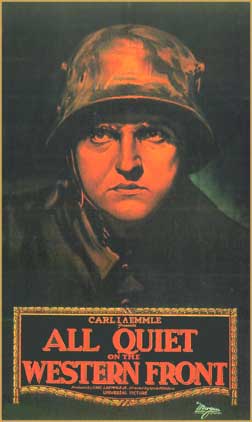
ALL QUIET ON THE WESTERN FRONT - WINNER in 1931


All Quiet on the Western Front (Universal - 130min)
Directed by Lewis Milestone
Starring Lew Ayres, Louis Wolheim, and John Wray
Genre: War, Drama, History

This is an English language film (made in America) adapted from a novel by German author Erich Maria Remarque. The film follows a group of German schoolboys, talked into enlisting at the beginning of World War 1 by their jingoistic teacher. The story is told entirely through the experiences of the young German recruits and highlights the tragedy of war through the eyes of individuals. As the boys witness death and mutilation all around them, any preconceptions about "the enemy" and the "rights and wrongs" of the conflict disappear, leaving them angry and bewildered. This is highlighted in the scene where Paul mortally wounds a French soldier and then weeps bitterly as he fights to save his life while trapped in a shell crater with the body. The film is not about heroism but about drudgery and futility and the gulf between the concept of war and the actuality.

Trivia: During the film's German release, the Nazis (not yet in power) interrupted screenings by shouting martial slogans and releasing rats into the theaters.

Also won: Best Director (Lewis Milestone)

SEE OUR TAKES BELOW!

All Quiet on the Western Front (1930): Shira's Take

Wow. Okay. First thing that I think must be said is that this movie is clearly not only still relevant, but also still haunting. A good example: a shot in the first big front-line battle scene has an enemy fighter (Frenchman? Englishman?) grasping the fence, about to get into the German trenches, when a bomb goes off, and all that remains when the smoke clears is his hands, still grasping the fence. This movie is about half made up of incredible, powerful, gut-wrenching scenes. Still, I found the scenes in between long and at times boring. I also had trouble following characters, which didn't seem so important in the end when they all ended up either dead or back home with amputated legs. One very noteworthy detail about this movie is that the protagonists are the Germans. The German efforts seemed so much more fruitless because I knew all the while that they would lose, and many of those not killed in the war would end up starving to death in impoverished post-war Germany. Eitan pointed out that all the actors were very American and their dialogues were written very American as well. This was brilliant; the only times I remembered that the boys I was rooting for were German was when I saw their Pickelhaubes. For a movie in which I didn't know most of the characters' names, All Quiet on the Western Front had some of the most incredible ensemble character development I've seen. Notes to myself: Maybe I saw this movie when I was significantly younger, and it is why I have such a strange fear of butterflies. 9/10

All Quiet on the Western Front (1930): Eitan's Take

This is undoubtedly one of the best anti-war movies ever made, as well as one of the superlative war stories ever committed to film. I would contend that it is also one of the best films ever made. Tracing the lives of half a dozen German teenage boys from their bloodthirsty school days to their deaths (most of them) and their utter disillusionment in the face of horror, All Quiet on the Western Front is unflinching, brutal, disturbing, somber, and very, very powerful. Certain scenes will come back to me for a long time to come: a patient and mournful interlude where a German soldier spends the night in a muddy pit with a French soldier he has just stabbed and killed, a horrifying shot of two blown-off arms still clutching onto a barbed-wire fence, and main character Paul's weary wanderings through a life back home where he clearly does not fit.

All Quiet on the Western Front is directed with a sort of angry grace. With no attention to formal plot structure, we lose track of the time our protagonists have spent in the war -- then, we are thrown out of the trenches and pummeled with a merciless, shocking battle sequence with ambitious cinematography and an aura of true sadness that you just can't feel outside of the context of watching such a wasteful and worthless war. The movie is not hopeful, but it is thoughtful and perceptive about how to portray the gradual extermination -- both physical and emotional -- of the young men we follow. By the time Paul shows up in his old classroom, with his old warmongering teacher, the bright-eyed students he sees in the classroom look like infants... and then we remember that he was no younger when he wandered into the war. Additionally, it was interesting to note that all the actors portraying German soldiers speak with the aw-shucks affect of 20th century American boys; this was no doubt on purpose, to remind us that the Germans were human too, and no different from the Americans and Brits they fought against.

A beautiful, powerful, sobering -- and absurdly well made -- film with an anti-war message to last through the ages. It isn't perfect, but it's essential watching for anyone who wants to see war cinema at its finest. 9/10

P.S. The mastery and potency of this film makes last year's winner (The Broadway Melody) look like phony kid stuff.

Saturday, March 17, 2007

THE BROADWAY MELODY - WINNER in 1930


The Broadway Melody (MGM - 100min)
Directed by Harry Beaumont
Starring Anita Page, Bessie Love, and Charles King
Genre: Musical, Romance

Hank (nee Harriet) and Queenie Mahoney, a sister vaudeville act, come to Broadway, where their friend Eddie Kerns needs them for his number in one of Francis Zanfield's shows. Eddie was in love with Hank, but when he meets Queenie, he falls in love to her, but she is courted by Jacques Warriner, a member of the New Yorker high society. It takes a while till Queenie recognizes, that she is for Jacques nothing more than a toy, and it also takes a while till Harriet recognizes, that Eddie is in love with Queenie.

Trivia: First "talkie" to win Best Picture. It did not win any other Oscars that year.

SEE OUR TAKES BELOW!