Sunday, April 22, 2007

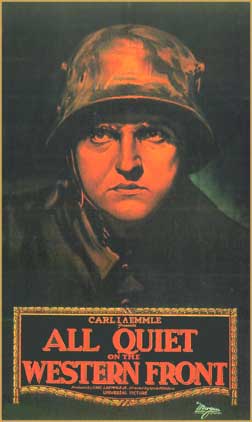
ALL QUIET ON THE WESTERN FRONT - WINNER in 1931


All Quiet on the Western Front (Universal - 130min)
Directed by Lewis Milestone
Starring Lew Ayres, Louis Wolheim, and John Wray
Genre: War, Drama, History

This is an English language film (made in America) adapted from a novel by German author Erich Maria Remarque. The film follows a group of German schoolboys, talked into enlisting at the beginning of World War 1 by their jingoistic teacher. The story is told entirely through the experiences of the young German recruits and highlights the tragedy of war through the eyes of individuals. As the boys witness death and mutilation all around them, any preconceptions about "the enemy" and the "rights and wrongs" of the conflict disappear, leaving them angry and bewildered. This is highlighted in the scene where Paul mortally wounds a French soldier and then weeps bitterly as he fights to save his life while trapped in a shell crater with the body. The film is not about heroism but about drudgery and futility and the gulf between the concept of war and the actuality.

Trivia: During the film's German release, the Nazis (not yet in power) interrupted screenings by shouting martial slogans and releasing rats into the theaters.

Also won: Best Director (Lewis Milestone)

SEE OUR TAKES BELOW!

All Quiet on the Western Front (1930): Shira's Take

Wow. Okay. First thing that I think must be said is that this movie is clearly not only still relevant, but also still haunting. A good example: a shot in the first big front-line battle scene has an enemy fighter (Frenchman? Englishman?) grasping the fence, about to get into the German trenches, when a bomb goes off, and all that remains when the smoke clears is his hands, still grasping the fence. This movie is about half made up of incredible, powerful, gut-wrenching scenes. Still, I found the scenes in between long and at times boring. I also had trouble following characters, which didn't seem so important in the end when they all ended up either dead or back home with amputated legs. One very noteworthy detail about this movie is that the protagonists are the Germans. The German efforts seemed so much more fruitless because I knew all the while that they would lose, and many of those not killed in the war would end up starving to death in impoverished post-war Germany. Eitan pointed out that all the actors were very American and their dialogues were written very American as well. This was brilliant; the only times I remembered that the boys I was rooting for were German was when I saw their Pickelhaubes. For a movie in which I didn't know most of the characters' names, All Quiet on the Western Front had some of the most incredible ensemble character development I've seen. Notes to myself: Maybe I saw this movie when I was significantly younger, and it is why I have such a strange fear of butterflies. 9/10

All Quiet on the Western Front (1930): Eitan's Take

This is undoubtedly one of the best anti-war movies ever made, as well as one of the superlative war stories ever committed to film. I would contend that it is also one of the best films ever made. Tracing the lives of half a dozen German teenage boys from their bloodthirsty school days to their deaths (most of them) and their utter disillusionment in the face of horror, All Quiet on the Western Front is unflinching, brutal, disturbing, somber, and very, very powerful. Certain scenes will come back to me for a long time to come: a patient and mournful interlude where a German soldier spends the night in a muddy pit with a French soldier he has just stabbed and killed, a horrifying shot of two blown-off arms still clutching onto a barbed-wire fence, and main character Paul's weary wanderings through a life back home where he clearly does not fit.

All Quiet on the Western Front is directed with a sort of angry grace. With no attention to formal plot structure, we lose track of the time our protagonists have spent in the war -- then, we are thrown out of the trenches and pummeled with a merciless, shocking battle sequence with ambitious cinematography and an aura of true sadness that you just can't feel outside of the context of watching such a wasteful and worthless war. The movie is not hopeful, but it is thoughtful and perceptive about how to portray the gradual extermination -- both physical and emotional -- of the young men we follow. By the time Paul shows up in his old classroom, with his old warmongering teacher, the bright-eyed students he sees in the classroom look like infants... and then we remember that he was no younger when he wandered into the war. Additionally, it was interesting to note that all the actors portraying German soldiers speak with the aw-shucks affect of 20th century American boys; this was no doubt on purpose, to remind us that the Germans were human too, and no different from the Americans and Brits they fought against.

A beautiful, powerful, sobering -- and absurdly well made -- film with an anti-war message to last through the ages. It isn't perfect, but it's essential watching for anyone who wants to see war cinema at its finest. 9/10

P.S. The mastery and potency of this film makes last year's winner (The Broadway Melody) look like phony kid stuff.

Saturday, March 17, 2007

THE BROADWAY MELODY - WINNER in 1930


The Broadway Melody (MGM - 100min)
Directed by Harry Beaumont
Starring Anita Page, Bessie Love, and Charles King
Genre: Musical, Romance

Hank (nee Harriet) and Queenie Mahoney, a sister vaudeville act, come to Broadway, where their friend Eddie Kerns needs them for his number in one of Francis Zanfield's shows. Eddie was in love with Hank, but when he meets Queenie, he falls in love to her, but she is courted by Jacques Warriner, a member of the New Yorker high society. It takes a while till Queenie recognizes, that she is for Jacques nothing more than a toy, and it also takes a while till Harriet recognizes, that Eddie is in love with Queenie.

Trivia: First "talkie" to win Best Picture. It did not win any other Oscars that year.

SEE OUR TAKES BELOW!

Friday, March 16, 2007

The Broadway Melody (1929): Shira's Take

I like to think that this movie just has not withstood the test of time. The optimist in me believes that if I had seen this movie in 1929, I may have liked it. As is, seen in 2007, it was boring, depressing, and lacking any purpose. The acting was bad, but that can be explained by the fact that the actors were the singing-and-dancing (and not acting) types. The plot was bad, but it had some good bits with Gift of the Magi-esque sacrifices on the parts of the Mahoney sisters (Queenie and Hank, played by Anita Page and Bessie Love). Basically, it had some entertaining revue numbers and snippets of interesting dramatic character development. Unfortunately, though, those factors do not add up to a good movie. Additional notes to myself: I don't understand how women in the 20s and 30s were not grossed out by wearing entire animals as shawls. Anita Page was adorable. The clothes were fantastic. 4/10

The Broadway Melody (1929): Eitan's Take

Sigh. Apparently this is "the grandfather of all movie musicals." In which case, it reminded me of a) why I pretty much disdain all movie musicals and b) why the ones that ARE good are so incredible at overcoming their lame musical identity that they pretty much have to win Best Picture (see West Side Story, My Fair Lady, and Chicago). This was a decent movie about a pair of whip-smart, button-cute Broadway revue performers who share a tiny apartment in Manhattan and take small roles, sleep with songwriters and financiers, and wear a lot of one-pieces and peacock hats on their way to the top. I guess by now we've heard it all before -- ambitious upstarts start at the bottom and Make It Big In New York -- but I'm content with judging this by the standards of the time. This was undoubtedly a fun Hollywood extravaganza, featuring razzle-dazzle stage productions and some slam-bang Ain't-Showbiz-Great writing, so I'm not surprised they went ahead and gave it the Oscar. Some aspects of it really gave me the creeps, though... especially the love triangle that was supposed to be funny but seems out of place here in its awkwardness and tragic implications.

Also, the songs are pretty much terrible. Considering the fact that I watched this film 10 minutes ago and can't for the life of me remember the tune of the title song reflects pretty poorly on this movie's claim to fame as the first great musical. Oh well. Anita Page and Bessie Love play their sister act singing team with a nice mix of sweetness and toughness, and they're blessed with spunk and that gorgeous flapper look, so I can't complain too much.

A decent film that highlights the awkwardness of Hollywood's transition into sound. I give it a 6/10.

Saturday, March 10, 2007

WINGS - WINNER in 1929

Wings (Paramount - 139m)
Directed by William A. Wellman
Starring Clara Bow, Charles "Buddy" Rogers, Richard Arlen, and Gary Cooper
Genre: Drama, Romance, War, Action

Jack works on his sports car and dreams of flying. His neighbor Mary is in love with him but he seems not to notice, having been smitten by the fair Sylvia, but he can't see that Sylvia has eyes only for David. The distant drums of war beckon, and Jack and David train to be pilots in the American Expeditionary Corp. Their rivalry soon evolves into camaraderie as they do aerial battle with the Germans in the skies over France. Meanwhile Mary has joined the Women's Motor Corp and despairs that Jack doesn't notice her.

Also won: Best Effects (Engineering Effects)

SEE OUR TAKES BELOW!

Wings (1927): Eitan's Take

Impressions

This is a pretty impressive film, and one of the last of the silent era to garner acclaim. The story is somewhat lacking... it's essentially Top Gun meets Pearl Harbor, but it has some incredible moments of pathos and some pure drama that make for an interesting watching experience. Most of the silent movies I see are Buster Keaton and Charlie Chaplin shorts (and the occasional feature length), so watching a true drama in silent form was new ground for me. Of course, I wasn't expecting slapstick, but I was truly surprised by how dramatic, intense, and focused this film could be, even within the constraints of silence and title cards.

Clara Bow is a really luminous actress, and it's no surprise that she slept with everyone in Hollywood. Despite her relatively small part, she truly carries this film. As the Mary Jane back home, she provides the heart and the yearning that set the tone for the entirety of the film. However, the screen presence of the two leading men is nothing to be scoffed at; they were entirely convincing as dashing but flawed WWI pilots, drawn into the war simply because it was their call of duty. It was fascinating to watch their personal dramas and growing camaraderie become as much of an emotional incentive to win the war for the Allies as their duty to their nation. This movie is also known as the first movie to ever feature a male-on-male kiss, but we waited in vain for a Heath-Jake-style makeout session and felt pretty stupid when the kiss shown was a very honorable and chivalrous farewell to a friend. The heart-wrenching dramatic irony of a pilot shooting down his own best friend was portrayed gracefully and without any of the overwrought emotionalism that plagues a lot of silent films.

The best part of this film, however, is the dogfighting, and the spectacle is definitely worth the price of admission. Some of the cinematography techniques were just mindboggling -- the kind of thing you didn't know existed back then. There's also a really brilliant tracking shot that flows energetically and smoothly through the crowd and over several dinner tables in a beautiful French cafe while the flyboys are on leave from war. Visually, the film is a totally believable representation of the horrors and oddities of war. Extended montages showing massive trench battles take up most of the middle portion of the movie, and they're pretty intense. Definitely not the cartoon war stuff I've seen in other silent films.

Why did this movie win Best Picture?
It's a a visually impressive movie that, while not a total war masterpiece, is a pretty powerful ode to friendship and love in war. For the first Best Picture ever, the Academy no doubt wanted to reward a movie with star power, cinema wizardry, high production values, a tragic story, and a movie that totally glorifies America in every way possible.

An overall decent movie that impressed me with its relevance and watchability. A worthy BP winner, definitely. 7/10

(Note to myself: BUBBLES!)
Wings (1927): Shira's Take

I haven't seen very many silent movies (my greatest exposure to them has been the mini-movies in Three Amigos), so I had very little idea what to expect. All I knew going into this movie was that Clara Bow was going to be adorable and that there was supposedly going to be a homoerotic scene. Now, I wasn't blown away, as many techniques (e.g. the shooting star at the end) and plot points in the movie are considered cheesy and old-fashioned nowadays, but I found quite a lot of what I like in modern classics--good acting, interesting characters with deep motivations and passions, and some cool camera shots. Notes to myself: Charles "Buddy" Rodgers (who played fighting ace Jack Powell) looked so much like Robert Downey Jr., only foxier. Richard Arlen (who played richer fighting ace David Armstrong) looked a little bit like Crispin Glover in his well-groomed but creepy phases. Also, Clara Bow looked so hott in her military uniform. All in all, 8/10.

Monday, February 19, 2007

Okay, Eitan said basically everything that needed to be said. It seems that we have everything worked out, and at this point, my only concern is keeping up with schoolwork.

Fortunately, movies are more important than school. Right?